110+ Business Operations & Technology Statistics (2025 Upldated)
Business operations did not always run on software.
In the early 2000s, companies began moving work from paper and servers to cloud tools. By 2010, cloud and mobile tech changed how teams worked. Today, global IT spending tops $4.7 trillion, and over 90% of companies use cloud services.
That scale now rivals spending on buildings and equipment. But rising AI costs, cyber risks, and system outages are forcing businesses to rethink how technology really supports daily operations. With that in mind, we’ll cover statistics that show patterns, predict trends, and inform effective business strategies.
Key Business Statistics
- There were approximately 359 million businesses worldwide as of 2023.
- A business plan increases the chances of growth by 30%.
- 35% of businesses have adopted AI technologies in their operations.
- 90% of prominent companies invest in AI.
- 95% of all product innovations fail.
Sources: (etailinsights, United States Census Bureau, Bureau of Labor, NRF, Zippa, Chad, NFR)
Business Plan Statistics
- 33% of small businesses have a formal business plan.
- 71% of the fast-growing companies have business plans.
- 58% of business started with a loose, “casual” business plan.
- Entrepreneurs with business plans are 260% more likely to launch.
- A business plan increases the chances of growth by 30%.
- Businesses with business plans grow 85.19% faster than those without.
- Business plans help companies get 133.33% more investment capital.
- 90% of organizations fail to execute their strategic plans successfully.
- A business plan increases the chances of growth by 30%.
- Approximately 70% of businesses that survive for 5 years follow a strategic business plan.
- 71% of fast-growing businesses have plans.
- Compared to businesses without a written plan, those with one had a 7% higher likelihood of experiencing high growth.
- One study found that only 35% of business owners who were surveyed had finished a business plan.
- Simply put, business plan finishers were twice as likely to succeed.
- 30% of businesses with business plans secured loans, compared to 12% without business plans.
- 28% of businesses with business plans secured investment capital, compared to 12% without business plans.
- 50% of businesses with business plans grew their businesses, compared to 27% without business plans.
- Business plans increased loan approvals by 150%.
Source: (Kaplan and Norton, Thryv, Wave Financial, Linkedin, Go business plans, Investopedia, Hbr, Smallbiztrends, Bplans)
Business Innovation Statistics: Key Numbers
- 84% of executives believed that innovation was critical to their future success.
- 95% of all product innovations fail, according to HBS professor Clayton Christensen.
- One in every five new products fails to meet customer expectations.
- 62% of fast-growing businesses intend to spend money on initiatives that boost innovation.
- Nearly 30% of companies actively include AI in their innovation plans. (Business Consulting Group)
- Compared to 44% of SMEs, 58% of large businesses were actively engaged in innovation.
- 84% of consumers cite innovation as being somewhat or very important in a company’s ability to sell them a product.
- 34% of consumers prefer to own products that make them appear innovative to others. 5
- Every year, an astounding 30,000 new products are introduced.
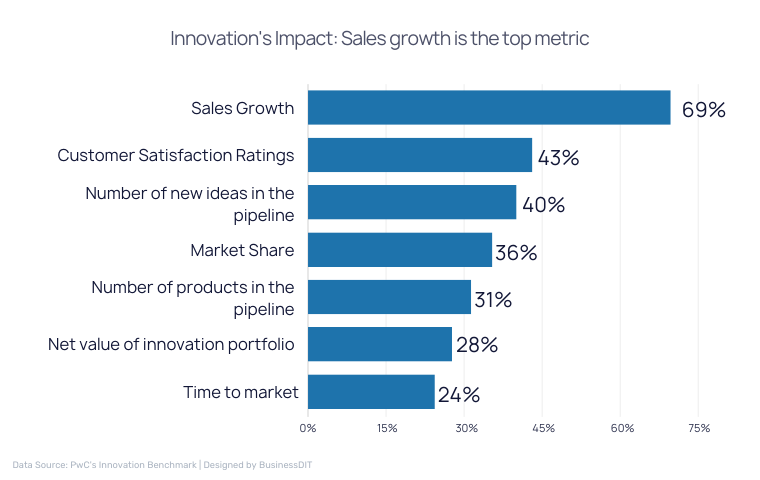
- 69% of companies cite sales growth as the most important metric for measuring innovation at their organization.
- 43% of companies consider customer satisfaction ratings among the most important metrics for measuring innovation.
- 40% of companies regard the number of new ideas in the pipeline as a critical metric for innovation.
- 42% of companies identify long development times as a common roadblock to innovation success.
- 32% of companies struggle with selecting the right ideas, as a barrier to innovation.
- 31% of companies cite a risk-averse culture as an obstacle to successful innovation.
- 25% of companies experience a lack of coordination as a hindrance to innovation.

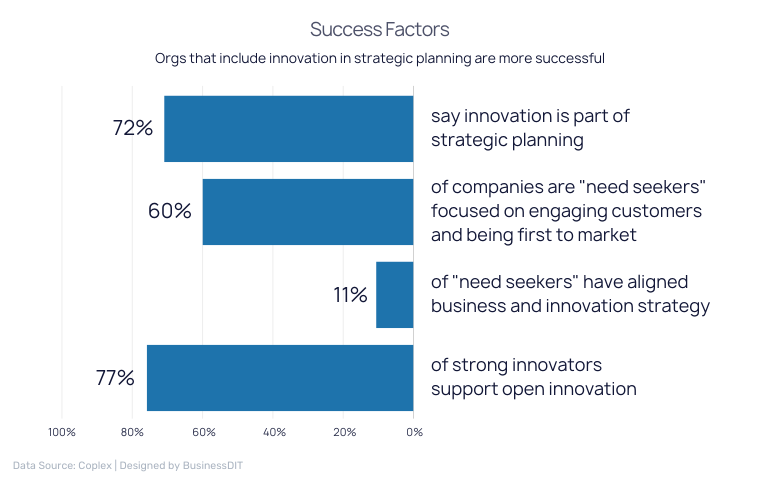
- 72% of organizations say innovation is part of their strategic planning.
- 60% of companies are “need seekers” focused on engaging customers and being first to market.
- 11% of “need seekers” have aligned business and innovation strategies.
- 77% of strong innovators support open innovation.
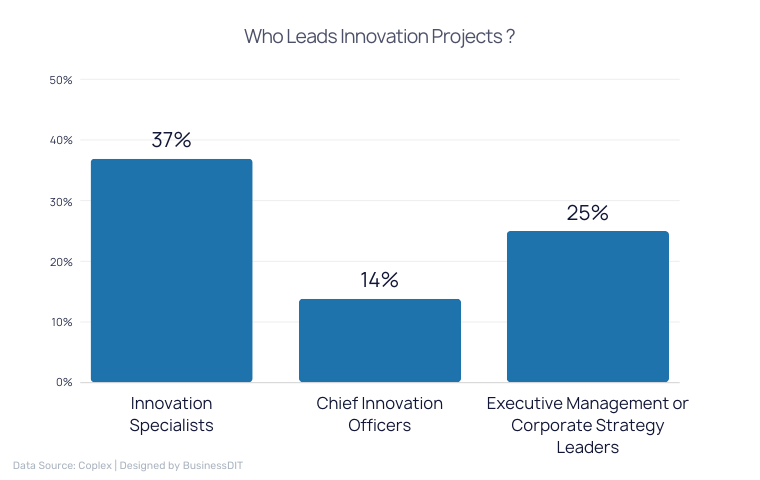
- 37% of innovation projects are led by innovation specialists.
- 14% of innovation projects are led by Chief Innovation Officers.
Source: (Accenture, HBS, Innvolo, PSG, CustomerThink, Nielseniq, PwC’s Innovation Benchmark, Coplex)
Product Launch Statistics
- Each year, more than 30,000 new consumer products are launched.
- 95% of new products fail.
- A product launch can cost anywhere from $10,000 to more than $10 million.
- Only 40% of products developed by companies survive on the market.
- 1 out of 5 consumers buys new products immediately after they are launched.
- 77% of buyers prefer different content at different stages of the product research process.
- 75% of consumer packaged goods and retail products fail to earn even $7.5 million in their first year.
- A total of 64% of consumers believe that effective new brand innovation can play a critical role in improving society.
- Only 3% of newly launched goods sell for more than $50 million in their first year.
- Only 55% of all product launches take place on time.
Source:
- Clay Christensen’s Milkshake Marketing | Harvard Business School
- Why 95% of new products miss the mark (and how yours can avoid the same fate) | Professional Programs
- Product Launch Checklist: How to Launch a Product, According to Experts | HubSpot
- 34 Product Statistics and Trends for Product Teams and PMs | UserGuiding
- 3 Stats That Will Change Your Product Marketing Strategy | Upland Software
- Solved Read the case carefully and answer all questions | Chegg
- Top Product Launch Statistics for 2022 | SaaSworthy
- Biggest Product Flops in History: Fire Phone, Virtual Boy, and More | Business Insider
- Gartner Survey Finds That 45% of Product Launches Are Delayed by at Least One Month | Gartner
Business Sustainability Statistics
- Products marketed as sustainable grow 2.7X faster than non-sustainable products.
- Corporate responsibility practices boost sales by 20%.
- 92% of buyers trust socially or environmentally responsible brands.
- 55% of consumers are willing to pay more for eco-friendly brands.
- Sustainable brands have 34% customer loyalty, compared to 27% for less sustainable brands.
- Sustainability-focused S&P 500 companies have 18% higher ROIs.
- $26 trillion in economic benefits when businesses go green.
- According to the IEA, going green costs $45 trillion.
- 33% of businesses use sustainability strategies to cut costs and increase efficiency.
- 76% of Americans expect businesses to fight climate change.
- 73% of Americans would stop buying from a company that does not care about climate change.
- 69% of organizations experience an increase in brand value due to sustainability initiatives.
- 69% of organizations see an increase in brand recommendations as a benefit of sustainability.
- 68% of organizations report an improvement in their ESG (Environmental, Social, and Governance) rating.
- 67% of organizations note an increase in employee motivation levels.
- 65% of organizations experience higher customer satisfaction scores.
- 61% of US customers consider sustainability before buying.
- 92% of buyers trust brands that are environmentally or socially responsible.
- 73% of Americans would quit buying from a corporation that ignores climate change.
- 73% of millennials will pay more for eco-friendly goods.
- 65% of Americans want corporations to drive social and environmental change in the absence of government action.
- 85% of global consumers are making more sustainable purchasing decisions than they were five years ago.
- 88% of consumers are more likely to be loyal to a company that supports social and environmental causes
Sources: (Statista, SlideTeam, SHRM, Capgemini Research Institute, Deloitte Insights)
Business Ethics & Compliance Statistics
- 52% of Americans say they have boycotted a company because of unethical business practices.
- 10.7% more profit is generated by businesses with high ethical standards as opposed to those without.
- 56% of employees believe companies with strong ethics perform better in the long run.
- 54% would accept a lower-paying position to work for a more ethical company.
- There is a 467 percent greater likelihood that organizations with robust cultures will have a positive effect on their employees than those with feeble cultures.
- 14% of employees across the globe were employed by ethical businesses.
- 21% of U.S. employees worked in workplaces with a strong ethical culture.
- 40% of employees who observe unethical behavior report it.
- 63% of customers want to see more ethical business practices.
- 84% of consumers think about a company’s ethics and values before making a purchase.
Sources: (Marketing Charts, Steering Point, Marquette, Ethics)
Business Compliance & Money Laundering Risk Statistics
- The estimated amount of money laundered globally in one year is 2 – 5% of global GDP, or $800 billion – $2 trillion in current US dollars.
- An estimated $100 billion to $300 billion in US currency is laundered each year.
- 22.0% of money laundering amounts to more than $1.5 million.
- 20.3% of money laundering amounts to $40,000 or less.
- The median money laundering amount was $301,606.
69.8% of money launderers had little or no prior criminal history.
- 755 involved money laundering cases were reported to US Sentencing Commission in Fiscal Year 2020 .
- By 2025, anti-money laundering software market is projected to reach $2.77 billion.
- Anti-money laundering activities recover only 0.1% of criminal funds.
- 70.6% of money laundering offenders were United States citizens.
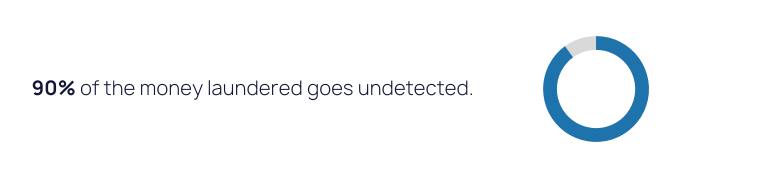
- 90% of the money laundered goes undetected.
- Suspicious Activity Reports (SARs) are responsible for the blocking of approximately 31% of laundered money each year.
- 69.8% of money launderers had little or no prior criminal history.
Business Coaching & Leadership Statistics
- The ROI for executive coaching was 788%.
- There are 64,438 businesses offering coaching services in the USA as of 2023.
- 77% of respondents said coaching had a significant impact on one of nine business measures.
- 86% of organizations saw a return on investment from their Coaching engagements, and 96% of those who worked with an Executive Coach said they would do it again.
- 70% of coaches claim to boost communication and job performance.
- One in every six entrepreneurs seeks coaching to improve their performance.
- Top performers make up 33% of founders who receive mentoring from successful business people.
- Only 22% of business owners have mentors when they first launch their companies.
- 92% of small business owners concur that mentors directly affect their ability to grow.
- 30% of company owners who engaged in just one mentoring interaction reported growth.
- Self-confidence growth is the most frequently reported advantage of business coaching (80%).
- 24% of business owners trust a business coach when it comes to important issues affecting their business.
- Business coaches are second-most trusted (24%), behind fellow business owners (31%).
- 31% of respondents believe that strategic planning is the area where a business coach would have the most impact.
- 61% of respondents rated the impact of their business coach as 7-9 on a scale of 10.
- The greatest benefit of receiving business coaching is accountability (31%), followed by growth and profitability (30%), and discussing concerns (26%).
- 46% of business owners would be more likely to retain the services of a business coach when the market is strong, compared to 54% when the market is weak.
- The most reliable method of finding the right business coach is through personal referrals (85%).
- 53% of respondents believe that reviews and testimonials from those who have used coaching services provide the greatest assurance before choosing a business coach.
Sources: (Gva Success, Ipec Coaching, Institute of coaching, Forbes, Techcrunch, Kabbage, Score, Upcoach, TAB)
Business Automation Statistics
- Automation can reduce costs by 10–50% by reducing labor costs and manual processing.
- 24% of businesses use job automation to cut operational expenses.
- 67% of businesses use business process automation solutions to improve end-to-end visibility across multiple systems.
- Almost all businesses (97%) agree that automating business processes is important for digital transformation.
- 90% of workers are burdened by repetitive tasks that can be automated.
- Nearly 45% of businesses use automation like AI to cut costs.
- At least one function in 31% of businesses has been completely automated.
- Growth in the automation systems market is expected to exceed $26 billion by 2025, up from $4.8 billion in 2018.
- 66% were testing automation solutions for at least one business process.
Business Risks of Automation Statistics
- 36% of businesses are worried about employees’ inability to adapt to automation.
- 32% of businesses fear that automation will lead to poor customer service.
- 47% of businesses are concerned about a loss of personal touch due to automation.
- 40% of businesses see the potential for job loss as a risk of automation.
- 23% of businesses are concerned about the lack of in-depth industry experience.
- 2% of businesses perceive inaccuracies as a risk of automation.
- 8% of businesses believe there are no business risks with automation.
Source: KRC Research via Statista.
Automation Impact On Business Statistics
- 99% of businesses see automation as having significant benefits.
- 52% of businesses note a reduction in manual errors due to automation.
- Automation improves work quality for 45% of businesses.
- 43% of businesses observe an increase in speed with automation.
- 43% of businesses find greater levels of productivity across experience levels with automation.
- 41% of businesses noted increased availability for themselves and other employees.
- 38% of businesses report increased utilization and productivity levels from automation.
- 31% of businesses see decreased labor costs due to automation.
Source: KRC Research via Statista.
Technology in Business Statistics: Key Numbers
- 90% of all SMBs make use of digital communications tools.
- 37% of businesses and organizations employ AI.
- 90% of prominent companies invest in AI.
- 85% of small business owners are finding success by utilizing technology in their businesses.
- 75% say AI will help them start new businesses.
- 44% of businesses have reported cost savings as a benefit of implementing AI.
- SAP (Business Applications and Technology) is used by 290,000 companies in over 190 countries.
- More than 2 million merchants utilize Square.
Importance of Technology in Business Statistics
- 59% of companies reported an impact in the realization of new revenue streams from their technology transformations over the past two years.
- 68% of companies experienced an increase in revenue from existing streams due to technology transformations.
- 76% of companies saw a reduction in costs as a result of their technology transformations.
- 79% of companies reported an improvement in employee experience from technology transformations.
Source: (Mckinsey)
Top Technology Challenges by Business Statistics
- 21.33% of businesses report keeping up with threats to data security as a major challenge.
- 16.67% of businesses face difficulties in ensuring employees are trained on how to use technology services.
- The cost of services is a notable challenge for 9.33% of businesses.
- 9.33% of businesses find managing remote work situations challenging.
- 9% of businesses struggle with the time needed to maintain services.
- 7.67% of businesses have issues with working with outdated technology.
- 6.67% of businesses report reliability and uptime as a significant challenge.
- 3.33% of businesses find that current tools are not adaptable to changing needs.
Source: (Statista)
Technologies Currently Used in SMBs Operations Statistics
- 80% of SMBs are using finance/accounting software.
- 75% of SMBs have implemented data and information security technologies.
- 65% of SMBs use HR software.
- 64% of SMBs are leveraging cloud computing.
- 61% of SMBs utilize customer relationship management (CRM) software.
- 60% of SMBs have adopted project management software.
- 59% of SMBs are using digital marketing tools.
Source: (Capterra 2019 Top Technology Trends Survey)
What SMBs Value Most in Technology Solutions Statistics
- 69% of SMBs consider ease of use as the most important factor when evaluating technology.
- 63% of SMBs prioritize a trustworthy vendor in their technology evaluation.
- 61% of SMBs view price as a critical factor in their technology decisions.
- 61% of SMBs place importance on the simplicity of maintenance when choosing technology.
- 61% of SMBs value speed and ease of setup as key factors in technology evaluation.
Source: (Salesforce Research)
Emerging Tech for Business Advantage Statistics
- 64% of organizations believe that big data/analytics will give them a competitive advantage in the next year.
- 50% of organizations see cloud technology as providing a competitive edge.
- 44% of organizations think artificial intelligence/machine learning will be advantageous.
- 29% of organizations consider robotic process automation to be a key competitive technology.
- 20% of organizations view the Internet of Things (IoT) as a technology that will offer a competitive advantage.
- 17% of organizations believe on-demand marketplace platforms will provide a competitive edge.
- 8% of organizations see augmented reality/virtual reality as a competitive technology.
- 7% of organizations think blockchain/distributed ledger will offer a competitive advantage, while 3% see the metaverse as providing a competitive edge.
Sources: (Statista)
The future of technology in business statistics
- 75% say AI will help them start new businesses.
- 90% of prominent companies invest in AI
- 63% of executives believe cloud computing and services will be particularly important in the next 3-5 years.
- 61% of executives think mobile solutions will shape the near future.
- 57% of executives see the Internet of Things as a key technology for the next few years.
- 37% of executives expect cognitive computing to be significant in the near future.
- 28% of executives consider advanced manufacturing technologies important for the upcoming years.
- 23% of executives believe new energy sources and solutions will be vital in the next 3-5 years.
- 12% of executives think bioengineering will be an important technology in the near future.
Source: (IBM C-Suite Study)
Workplace Productivity & Operations Statistics
Workplace distractions are a significant drain on American businesses, causing an estimated loss of up to $650 billion annually.
On average, employees lose approximately 2.1 hours per day due to distractions, taking them around 24 minutes to regain focus. Moreover, distractions lead to a 27% increase in the time taken to complete a task and cause 2X as many errors.
- On average, 84.4% of workers are distracted at work.
- 98% of workers experience at least three to four interruptions per day.
- Distractions cost workers an estimated 2.1 hours per day.
- It takes workers 24 minutes and 15 seconds to refocus after being distracted.
- The average worker wastes 60 hours every month due to workplace distractions.
- Distractions in the workplace cost American businesses as much as $650 billion annually.
- 55% of work productivity is lost due to the distraction of cell phones.
- Social media distractions cost businesses $4,500 per employee per year.
- 24% of workers miss deadlines due to distractions.
- Distractions can lead to employees making 2X as many errors as usual.
Sources: (BusinessDIT, Telegraph, Time Doctor.)
Slack Adoption Statistics Among Businesses
- 950K+ organizations around the world use Slack.
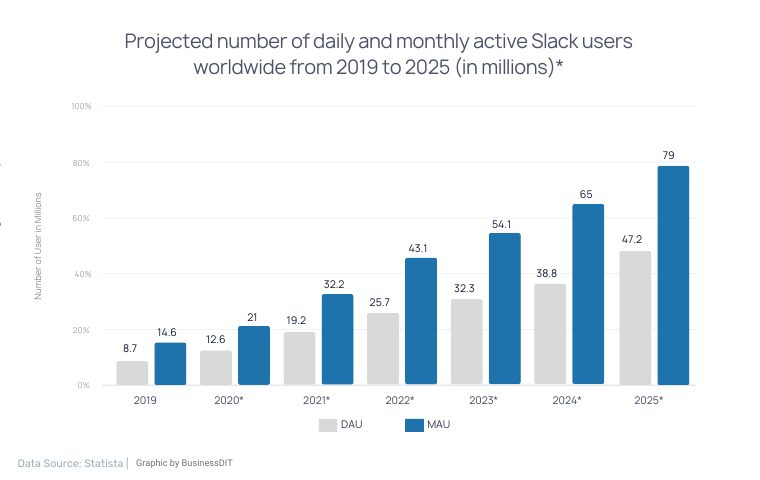
- Slack has 32.3 million daily active users in 2023, with that number expected to grow to 47.2 million by 2025.
- Slack surpasses 1 billion minutes of usage every weekday.
- Slack made $273.4 million in sales in Q1 2022, a 36% increase year on year, and its revenue is expected to exceed $4.22 billion by 2025.
- Slack controls 22.75 percent of the market.
- 77 of the Fortune 100 companies rely on Slack
Sources: (Statista, DemandSage)
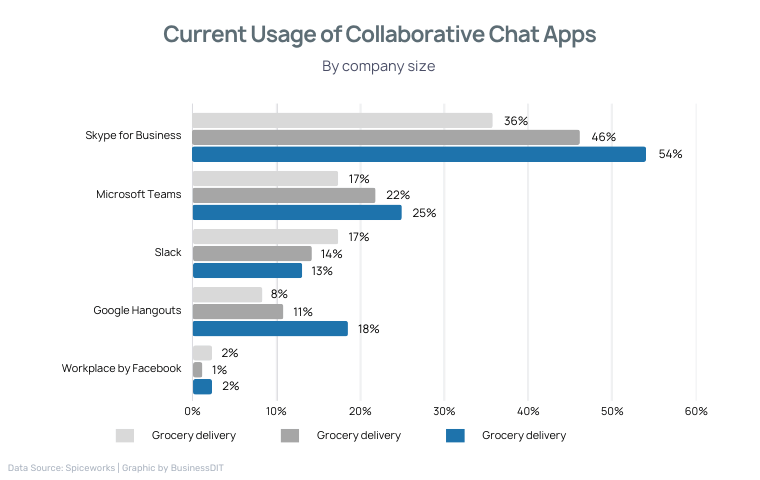
- 53% Skype for Business
- 41% Microsoft Teams
- 18% Slack
- 12% Google Chat
- 1% Workplace from Meta
Search Engine Usage Statistics for Businesses
- YouTube is the second largest search engine with 3 billion searches every month.
- 93% of all web traffic comes through search engines.
- Approximately 2.2 trillion search queries are processed by all search engines each year.
- As of April 2023, Google controls 92.82% of the search engine market.
- 68 percent of the online experiences normally start with the search engine.
- Google processes over 8.5 billion searches every day.
- 45.25% of first-page clicks come from Google Search.
- Latest December 2021 global search engine market share as follow: Google(91.94%), Bing(2.86%), Yahoo(1.5%), Baidu(1.37%), Yandex(1.1%), DuckDuckGo(0.67%), and all others(0.47%).
- Google captures 78% of desktop search traffic and 89% of mobile search traffic.
- Google process 63,000 search per second, 3.8 million search per minute, 5.6 billion searches per day, and approximately 2 trillion searches each year.
- Yahoo process 63.65 thousand search per minute, 2.75 billion search per months, 33 billion in year globally.
- Bing process 121 thousand search per minute, 5.24 billion search per months, 62.92 billion in year globally.
- 85 percent of those who use Bing search engine are from the United States
- 46% of all Google searches are linked to something nearby.
01.
Business Analytics & Measurement Statistics
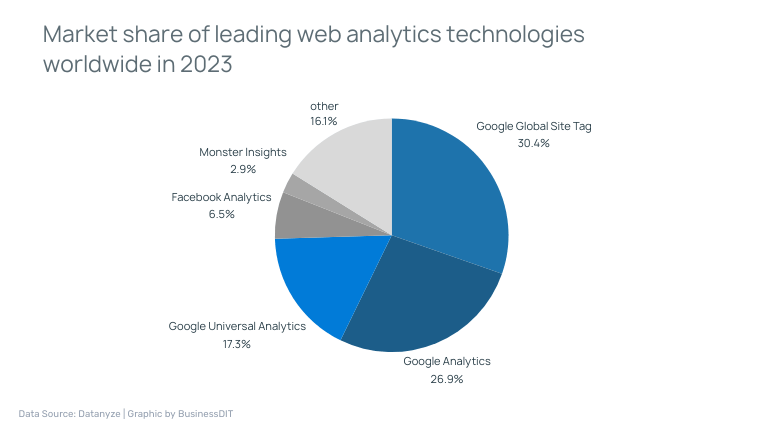
- Google Analytics is used by 55.49 % of all websites.
- 86% of all websites that use traffic analytics tools are using Google Analytics.
- Approximately 37.9 million websites use Google Analytics.
- 30+ languages are supported by Google Analytics.
- Google Analytics is used by 71% of small businesses under 50 employees, 6% of large businesses over 1000 employees, and 23% of medium-sized businesses.