
95+ B2B AI Statistics for Business Operations (2025 Updated)
AI did not start with a big bang. It started quietly in the early 2010s as companies used basic automation and data tools to save time.
By 2023, AI exploded into daily business use, with over 55% of companies adopting AI tools in sales, marketing, and operations. That growth is faster than cloud software adoption at the same stage. Now in 2024 and 2025, rising costs, data trust, and regulation are forcing businesses to rethink how they use AI.
With that in mind, we’ll cover a range of AI statistics that highlight its impact and future potential for B2B marketers and enterprises. and that makes these statistics matter more than ever.
AI in Business Statistics: Key Numbers
- As of 2024, an estimated 35% of businesses use AI.
- By 2030, AI is expected to contribute $15.7 trillion to the global economy.
- The AI market is expected to surpass $826 billion by 2030.
- 51% of e-commerce businesses employ AI.
- 85 million jobs will be lost to automation worldwide by 2025.
- AI is projected to create around 97 million new jobs by 2025.
- AI in sales helped companies get 50% more leads.
Source: (Gartner, Valuer, TextCortext, World Economic Forum )
AI Market Size
The AI market is booming and changing fast, showing how it’s impacting different areas. Check out these key stats to see how much it’s growing:
- The AI market grew to over $184 billion in 2024, up nearly $50 billion from 2023.
- The AI market is expected to surpass $826 billion by 2030.
- The AI market is expected to experience a remarkable compound annual growth rate (CAGR) of 33.2% from 2021 to 2028.
- The global AI software market is expected to reach an impressive $126 billion by 2025.
- The AI market for cybersecurity is projected to reach a staggering $38.2 billion by 2026.
- The AI market for customer service is expected to reach an impressive $24.6 billion by 2026.
- The AI market for autonomous vehicles is set to soar to a remarkable $54.23 billion by 2026.
Sources: (Statista)
AI Usage in Business Statistics
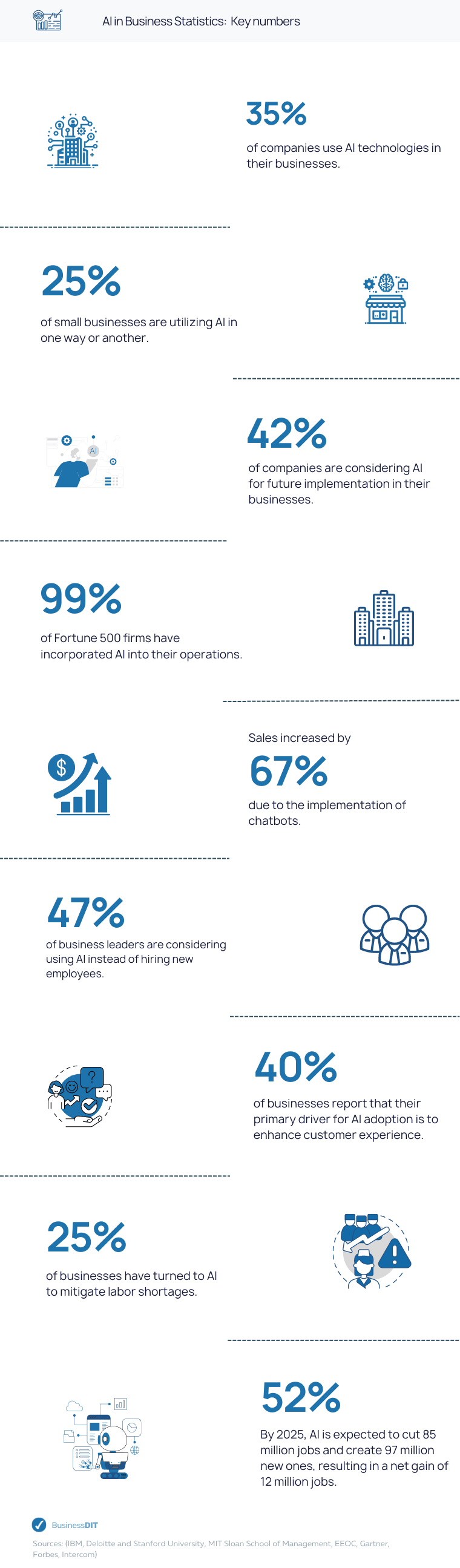
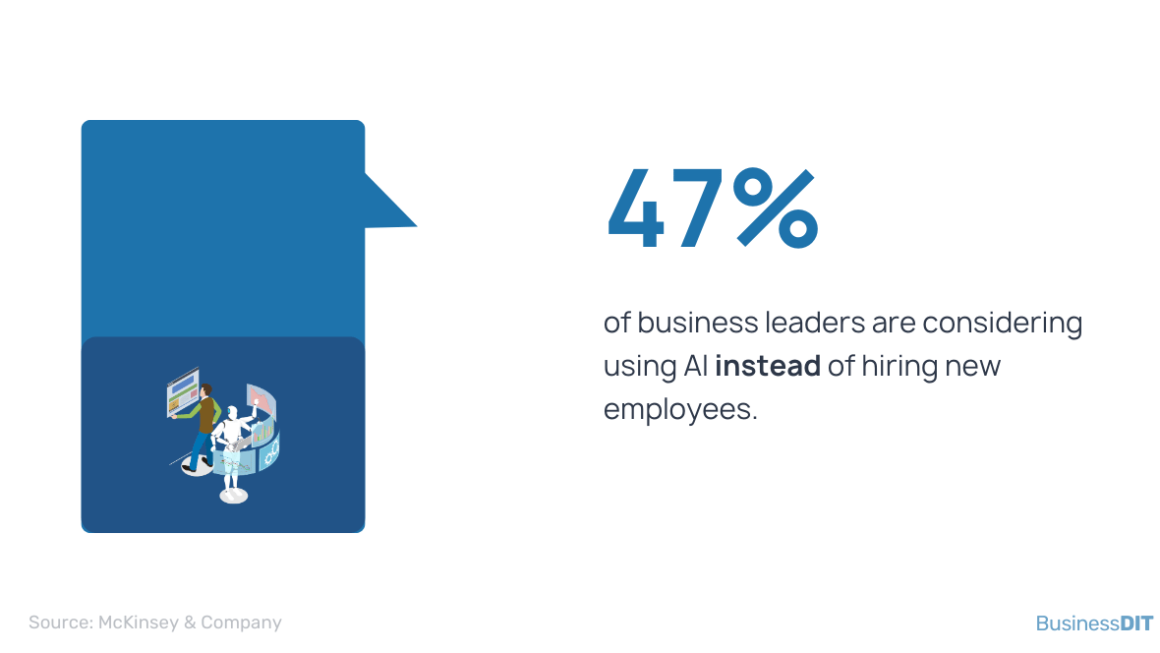
- 47% of business leaders are considering using AI instead of hiring new employees.
- Over half (56%) are leveraging AI to streamline and optimize their business operations.
- 51% of business are adopting AI to enhance their cybersecurity and fraud prevention efforts.
- 46% are using AI for customer relationship management.
- 2 in 5 are adopting AI for better inventory management.
- 30% are adopting AI tools for accounting support and supply chain operations.
- 25% of businesses have turned to AI to mitigate labor shortages.
- 75%of small businesses are using AI for a wide variety of business functions.
Sources: (Forbes,IBM, SMALL BUSINESS AI ADOPTION SURVEY, McKinsey & Company
AI Adoption in Business Statistics
- 35% of businesses have adopted AI technologies in their operations.
- 25% of small enterprises are utilizing AI in one way or another.
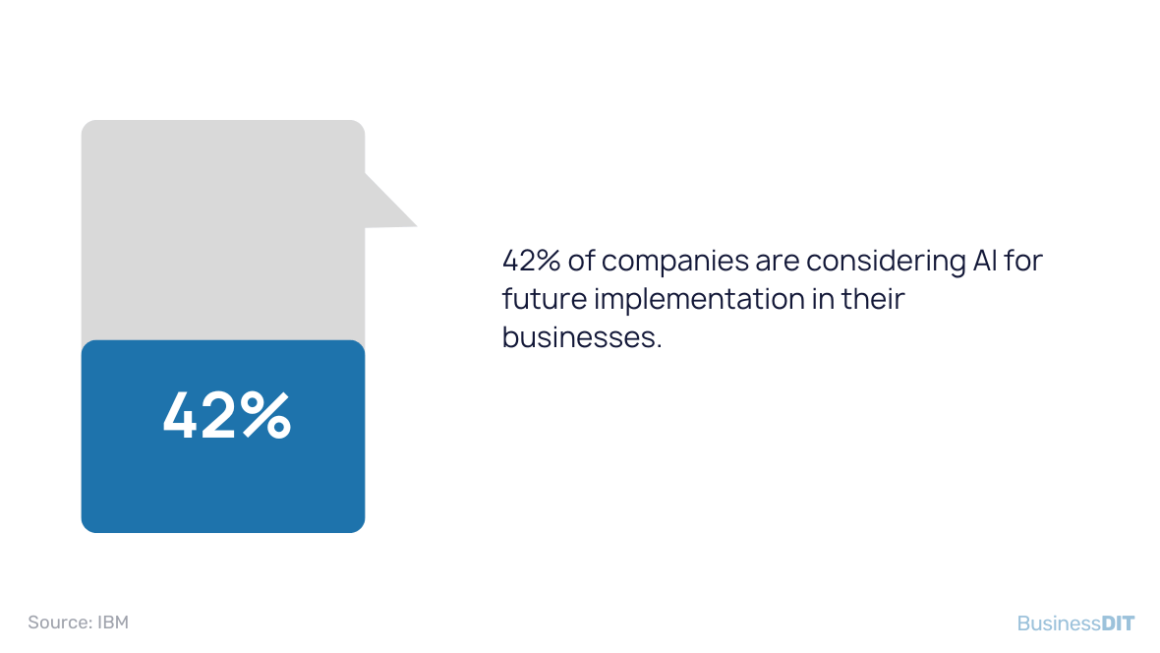
- 42% of companies are considering AI for future implementation in their businesses.
- AI is being used by more than 50% of large companies with over 5,000 employees.
- 12% of companies in sectors like manufacturing, information services, and health care have integrated AI, compared to 4% in construction and retail.
- 99% of Fortune 500 firms have incorporated AI into their operations.
- There was a 270% growth in business adoption of AI from 2015 to 2019.
- 40% of businesses report that their primary driver for AI adoption is to enhance customer experience.
Sources: (IBM, Deloitte and Stanford University, MIT Sloan School of Management, EEOC, Gartner)
AI in the Workplace Statistics
AI is transforming the job market, with automation set to impact millions of workers worldwide. Here are some key statistics that show just how big this shift will be:
- 81% of employees believe AI improves their job performance.
- 56% of office workers report using AI as part of their regular job duties.
- 89% believe AI could support them in up to half of their everyday work activities.
- 61% reported that AI made their workdays more productive and efficient.
- 49% thought AI enhanced their ability to make decisions.
- 51% think that using AI at work helps them strike a better work-life balance.
Source: (World Economic Forum, PWC, Brooking Institution,PWC, The Register)
AI in Cybersecurity Statistics
AI is transforming cybersecurity, making it crucial for detecting threats, predicting attacks, and responding effectively. Check out these key stats on how businesses are using AI to stay secure:
- 51% of businesses use AI primarily for threat detection, 34% heavily for prediction, and 18% for response.
- 62% of enterprises have fully implemented AI for cybersecurity or are exploring additional uses.
- Today, 71% of organizations spend more on AI and machine learning for cybersecurity than two years ago.
- The market for artificial intelligence in cybersecurity is expected to reach USD 133.8 billion by 2030, driven by an increase in the number of cyber attacks.
- As of 2027, the global market for AI cybersecurity technologies is expected to grow at a compound annual growth rate of 23.6%.
- AI is used for security by more than 80% of telecommunications companies.
Source: (GlobeNewsWire, Oracle, Webroot, Meticulous research, Capgemini)
AI in Sales Statistics
AI is totally changing the game in sales, bringing in huge benefits. The following statistics highlight how AI has proven its value in various aspects of sales operations, from lead generation to cost reduction:
- AI in sales helped companies get 50% more leads.
- Implementing AI in sales slashed call time by 60-70%.
- AI in sales helped companies cut costs by 40-60%.
- 79% of survey respondents believe AI in marketing and sales has increased revenue.
- AI in sales improves customer service analytics and segmentation.
- 57% of successful firms use AI.
- At 11 CARG, the sales market for AI is expected to reach 4 billion by 2027.
Sources: (HBR, McKinsey & Company-1, GlobeNewsWire)
AI in Market Research
AI is changing the game in market research, making it faster and smarter. Check out these stats:
- 80% believe AI will have a positive impact on market research.
- AI is viewed as an opportunity by 93% of researchers and a threat by 7%.
- 63% believe AI will take over data analysis within the next ten years.
Sources: (Qualtrics, qualtrics.)
AI in Manufacturing Statistics
Manufacturing is becoming faster and more efficient with AI. Here are some key stats showing how AI is being used and its future potential in the industry:
- According to the manufacturers, implementing AI reduces production time by 50%.
- On a global scale, 64% of manufacturers use AI in their operations.
- The Artificial Intelligence in Manufacturing Market was valued at USD 1.82 billion in 2019 and is expected to grow at a CAGR of 24.2% to USD 9.89 billion by 2027.
- 23 percent of manufacturers polled believe they lack the talent to properly leverage AI.
- AI technologies are anticipated to increase production by at least 40% by 2035.
- A survey on AI adoption in manufacturing by Deloitte found that 93% of businesses think AI will be a key technology to spur growth and innovation in the industry.
- Quality control is cited as the most significant application of artificial intelligence (59 percent).
Sources:(Fortune Business Insights, Deloitte, MIT Technology Review Insights, Google).
AI in Supply Chain Statistics
AI in the supply chain is transforming efficiency and accuracy. Key benefits and statistics include:
- AI in the supply chain can cut prediction errors by 20 to 50%.
- Implementing AI can reduce sales losses by 65%.
- AI can reduce overstocking of inventories by 20–50%.
- Early AI adopters in supply chain management reported 15% lower logistics costs, 35% higher inventory levels, and 65% higher service levels.
- By 2028, the market for AI in supply chains is expected to reach USD 20 billion and grow at a CAGR of 20.5%.
Sources: (McKinsey, BlueWeave Consulting and Research)